Product Marketing vs. Brand Marketing: How They Power Your Go-to-Market Strategy
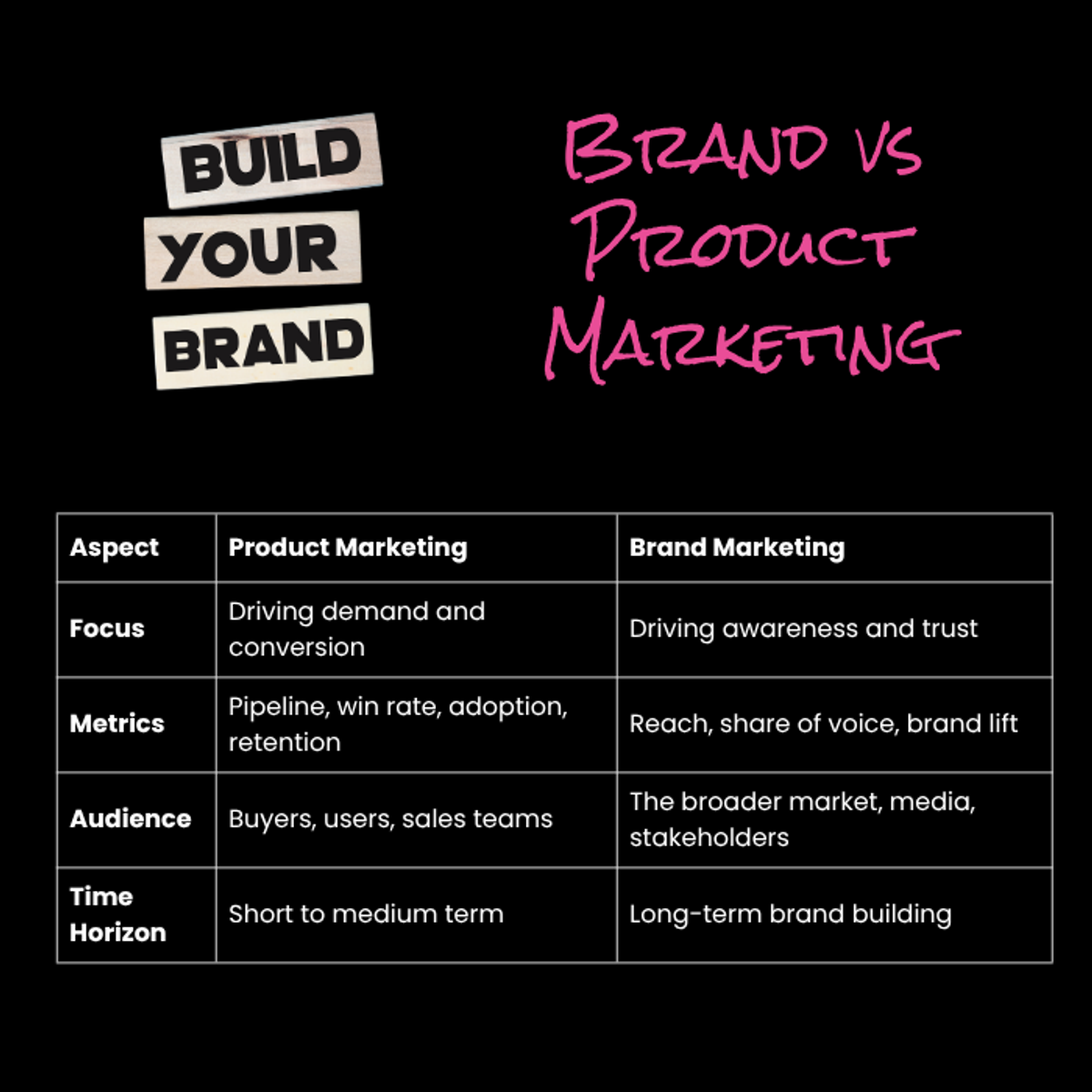
Being clear on the difference between product marketing and brand marketing can make all of the difference in your go-to-market strategy. Many times, we see teams blurring the lines between the two. Expecting conversions from brand marketing or awareness from product marketing.
While product marketing could drive awareness and brand marketing could drive conversions, the more likely scenario is you end up with mixed messages, wasted budget, and a GTM plan that doesn’t hit its potential.
It’s like confusing your pit crew with your hype crew. One’s there to fine-tune the engine and shave seconds off your lap time (product marketing). The other’s waving flags, amping up the crowd, and making sure everyone remembers your name long after the race (brand marketing). Both are essential, but you wouldn't want them swapping jobs mid-race.
What Is Brand Marketing in a GTM Context?
Brand marketing is the emotion. It fires up the crowd, gets the sponsors talking, and makes sure that the competition is paying attention. It's all about building up the excitement and brand loyalty so that when the pit crew (product marketing) rolls the car onto the track, the fans are already on their feet.
This is your “top of funnel” air cover. The roar before the race begins. It gets the market to care before they need you and remember you long after they do.
Core Responsibilities
- Visual identity and voice
- Content marketing and storytelling
- Awareness campaigns
- Social media thought leadership
- Brand equity measurement
Primary Goal
Increase brand awareness and preference, measured by growth in branded search traffic, share of voice, and conversions that reduce customer acquisition cost (CAC).
What Is Product Marketing in a GTM Context?
Product marketing lives where your offering meets the market. It’s about understanding your ICP (ideal customer profile), nailing positioning and messaging, and building the GTM toolkit to enable sales. This is your pit crew. They know the track conditions, understand exactly what the driver (sales) needs to win, and fine-tune every detail for maximum performance. They’re in charge of handing over the tools and data that keep you ahead of the competition.
Think of it as the “middle to bottom of funnel” horsepower that turns momentum into wins.
Core Responsibilities
- Positioning & messaging frameworks
- Launch planning and execution
- Sales enablement (battlecards, one-pagers, decks)
- Competitive intelligence
- Customer feedback loops
Primary Goal
Drive revenue by ensuring your product resonates with the right people at the right time.
When Product Marketing Leads GTM
Start ups and new products tend to lead product first. This is a scenario where you're introducing a new solution to a known problem, sales needs immediate enablement, the market is competitive and differentiation is key.
Use Case
A new AI SaaS tool launching into an established health tech workflow category. Product marketing owns the ICP, runs message testing with SDRs, and delivers the sales pitch. Brand is supportive, but GTM leans product-heavy.
When Brand Marketing Leads GTM
Brand marketing tend to takes the wheel when you’re entering a crowded market and need to stand out, you’re repositioning or reintroducing a product, you’re building community or thought leadership.
Use Case
A mental health startup launching in a sensitive space where trust and education are more valuable than features. Brand marketing creates a movement; product follows.
Syncing Brand and Product Marketing
The best GTM strategies aren’t brand or product. They’re brand and product, moving in sync. When brand and product marketing are synced, you get:
✅ A clear message that scales across channels
✅ Better campaign performance
✅ A pipeline that’s warmed up before the first cold call
✅ Sales that close faster because the market already trusts you
What does this look like? Well, let's say your health tech product team is pumped to launch a new AI integration tool that is going to make billing in a physician's office 10 times faster.
- Product Marketing: Builds the use case, value props, and partner sales enablement.
- Brand Marketing: Crafts a narrative that physician's and practice managers will recognize and trust, pushing it across paid, organic, and PR.
Now you’re not just announcing a feature. You’re making a coordinated statement that the market (and your competition) can't ignore.
Sync Up With Us!
If you're interested in learning more about syncing your brand marketing and product marketing efforts, scheduled your 30-minute consultation today. We'll have your team humming on all 8 cylinders in no time!